Don't negotiate blind.
Every asking price is either low, in line, or high against what has actually sold. PriceVero tells you which — with a purchase price in hand or a listing link from a property portal.
1,684 residential projects · 148 industrial projects · 9,700+ HDB blocks
Free account, one click, no card. What you enter here carries over.
Three steps, one answer
The whole product, in the order you meet it.
What a rating looks like
Rated 0 to 100 against the previous sale transactions. Type a price or paste a link — one rating, either way.
Evidence dated 28-07-2026
What the answer means
One question: is this asking price low, in line, or high against the evidence for this size, in this project? The 0-to-100 figure is that answer at a finer grain — not a quality score, and a high number is not advice to buy.
PriceVero does not tell you what to offer, does not predict what you will save, and is not a valuation — it puts the transacted record in front of both sides of the table.
Why the number holds up
A price is half the question. The other half is the building, and that half you keep for thirty years. Every reading is measured from an official record, and every rating states which ones it actually had evidence for.
Rebuilt every day — residential, industrial and HDB alike — and every rating carries the date of the evidence behind it, so you can see how fresh it is.
What we will not tell you
The most useful thing a rating service can do is be clear about its own edges. These are ours.
- New launches get no rating. A rating needs resale history. Roughly three in five listings we see are new launches.
- Landed is out of scope. We cover condominiums, apartments and ECs, industrial, and HDB resale — HDB is rated on its own scale, against other HDB resales, never against a condo.
- Industrial is rated on its own scale. Fewer price signals and no floor reading, so an industrial score and a residential score are not the same measurement — the same way an HDB score is not a condo's.
- No floor reading for one project in five. If every recorded sale sits in one floor band, there is no premium to measure.
What the record already answers
Nine pieces, each argued from the same transacted record a rating is built on — no opinion, and no advice to buy.
The PSF trap: why the bigger unit looks cheaper
Price per square foot falls as homes get bigger, so comparing psf across sizes points the wrong way — and it is the number every listing leads with.
- What a higher floor is actually worth 82% in the raw record, about 7% inside one block
- What sellers ask, and what buyers actually pay The gap: about 2% in HDB resale, 14% in industrial
- Cash Over Valuation, read from the resale record Why nobody can tell you your COV before the Option to Purchase
- The flats that become sellable 20,064 flats reach the end of their MOP in 2027
Wherever you are looking
One account, three places to use it: on the listing page itself, on a page for the building, and across a shortlist.
The rating, on the listing page itself
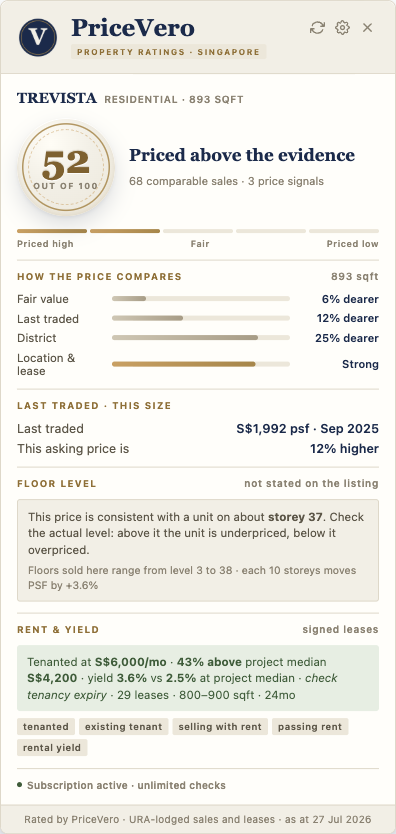
Included with every plan, the free one too. A tab waits at the edge of every supported listing; open it and the rating is already there — the score, the comparables, the floor the price implies and the rent check, beside the asking price.
A page for every building
Asking prices change. The building does not. Every project has a page you can read without an account — what it has sold for, what it rents at, how much lease is left, and an A-to-E building rating. Browse 1,684 residential · 148 industrial · HDB resale by town.
703 HDB flats and 1,363 condo units across Singapore are asking less per square foot than similar-sized homes in their own block or building have recently transacted at. That is not a list an agency's system can produce: it holds the sales, and this needs the sales and every live asking price read against each other. See which HDB blocks · See which condos.
Settle the shortlist
By the time you decide, you are choosing between units that are not comparable by eye — a bigger one on a low floor with a shorter lease against a smaller one by the station. One table, one scale, every signal lined up. Open Compare →
See beyond the asking price.
One subscription covers the website and the extension. A paid plan lifts the limits and adds reports, price alerts and Compare.
Questions
Do I need the extension to use PriceVero?
No. The website is the product — paste a link, get the rating; browse a project, get its page. The extension is included with every plan and puts the same ratings on the portal pages themselves, which is convenient rather than necessary.
Is one subscription enough for both?
Yes, and there is no other option. Your plan decides what you can do — how many ratings, how many reports, commercial use — never which surface you may open.
Does every listing get every signal?
No, and the rating says so. A project with too few transacted sales cannot have its own price curve, and industrial has no floor reading at all. Each rating states how many signals it had evidence for, and a listing with too few gets no rating rather than a guess.
Why is the buyer plan a 90-day pass rather than a subscription?
Because a property search lasts about ninety days, and a monthly subscription for a ninety-day need means remembering to cancel something. The pass does not renew. When it ends the account drops to free Owner Mode, which keeps a free monthly allowance of ratings for the home you bought.
Is a rating a valuation?
No. Valuation is a licensed activity in Singapore and a formal valuation carries legal weight for lending and stamp duty. A PriceVero rating is derived from public records and is not prepared by a licensed valuer. More on condo valuation and HDB valuation and COV.
How much is my property worth?
We will not print a figure — stating what a specific property is worth is a licensed activity, and a single number hides how much evidence stands behind it. Bring a price instead: name the project, the size on record and your figure, and the check reports how it reads against the record, with the comparable sales shown.
Where does the data come from?
Caveats lodged with URA, rental contracts lodged with URA, PriceVero's own industrial research, MOE school data, LTA rail data and OneMap routing. Every rating carries the date of the evidence behind it.
Do you cover HDB flats?
Yes — HDB resale. Each covered block has a page with its recent resale transactions (published by HDB under the Singapore Open Data Licence), remaining lease and an A–E block rating measured within HDB only, never against a condo. You can also check a specific asking price by naming the block, flat type and size. Landed property remains out of scope.
Check one price. Free.
Twenty free checks and five detailed reports when you sign up, then five a month. No card, nothing to cancel.